

Most small businesses approach SEO by writing pages they think their customers want, optimised for keywords they assume their customers use. The problem is that “think” and “assume” are doing a lot of heavy lifting in that sentence, and they’re usually wrong.
Real keyword research means finding out what people actually search for, what’s realistic for you to rank for, and matching the two. It’s not glamorous. It is the single piece of upfront work that decides whether all your other SEO efforts pay off.
Here is how to do keyword research for a small business without expensive tools or specialist training.
Why most keyword research goes wrong
The classic mistake: a small business owner brainstorms a list of words they think describe their business (“premium plumbing services Johannesburg”), assumes those are the keywords to target, and writes their website around them.
Three problems:
- Nobody actually searches that way. Real searches are simpler (“plumber Bryanston”) or messier (“emergency plumber 24 hour northern suburbs jhb”).
- The keywords they pick are too competitive. “Premium” anything is fighting national-scale competitors.
- The keywords don’t match purchase intent. Someone searching “what is a heat pump geyser” isn’t ready to buy; someone searching “heat pump geyser installation cost Sandton” is.
Good keyword research solves all three.
Start with intent, not volume
Before you research keywords, classify them by intent. There are four main types:
- Navigational. The searcher is looking for a specific site. “Facebook login”, “tigerandtype.com”. Not your battle to fight.
- Informational. The searcher wants to learn. “What is SEO?”, “How long does a kitchen renovation take?”. Useful for blog content and building authority.
- Commercial. The searcher is researching before buying. “Best plumbers in Johannesburg”, “WordPress vs Wix”. Useful for comparison content and reviews.
- Transactional. The searcher is ready to buy. “Hire a plumber Bryanston”, “WordPress designer Johannesburg”. This is where money lives.
For most small businesses, the priority is transactional keywords first (your service pages), commercial keywords second (comparison content), informational keywords third (blog posts that build authority). Get the order right.
The “what would they type” exercise
Before any tools, do this:
- Write down every service or product you offer.
- For each one, list 10 ways a customer might describe it. Use the words they would use, not the words you’d use.
- Add location modifiers (city, suburb, “near me”).
- Add intent modifiers (cost, price, near me, best, reviews).
This is your starting list. Most of it will be useful. Some of it will be too vague or too competitive. The next step refines it.
Free tools that work
You don’t need a R3,000-a-month tool to do useful keyword research. The free options:
- Google itself. Type a phrase into the search bar and look at the autocomplete suggestions. Look at “People also ask” boxes. Scroll to the bottom and look at related searches. All of these are real queries Google is showing you.
- Google Search Console. If you already rank for anything, GSC tells you exactly what queries you’re appearing for. Many of those will be keywords you didn’t even know you were targeting.
- Google Keyword Planner. Free with a Google Ads account, even if you never run ads. Gives you rough search volumes for South Africa.
- AnswerThePublic. Free tier shows you what questions people ask around a topic. Excellent for blog content ideas.
- Ubersuggest, Keywords Everywhere. Freemium tools with useful free tiers for small businesses.
Spend an hour across two or three of these and you’ll have a much better keyword list than 90% of your competitors.
The competition question
For each keyword on your refined list, ask: realistically, can my website rank for this?
A rough test: Google the keyword and look at who ranks. If page one is filled with national chains, big publishers, and businesses with 500 reviews, you’re going to struggle. If page one includes smaller local sites comparable to yours, you’ve got a shot.
This is why local modifiers are gold. “Plumber” is impossibly competitive. “Plumber in Bryanston” might be one or two competitors deep, and you can win it.
Long-tail versus head terms
“Head terms” are short, generic keywords with high search volume and brutal competition. “SEO”. “Plumber”. “Web design”.
“Long-tail keywords” are longer, more specific phrases with lower individual search volumes but much higher conversion rates and far less competition. “Affordable SEO for small businesses in Pretoria”. “Emergency plumber Bryanston 24 hours”. “WordPress web designer Johannesburg”.
For almost every small business, the right strategy is to chase long-tail keywords. Ten long-tail keywords each bringing 30 visitors a month will outperform one head term you’ll never rank for. And the long-tail traffic converts better, because the searcher’s intent is clearer.
How to organise your keyword list
Build a simple spreadsheet with these columns:
- Keyword
- Intent (informational, commercial, transactional)
- Rough search volume (from Keyword Planner)
- Difficulty assessment (low, medium, high, based on your competition check)
- Target page (which page on your site this keyword belongs to)
- Status (do you currently rank, target only, etc.)
This becomes your roadmap. Every page on your site should have one primary keyword and two or three secondary ones. Every blog post should target a specific question or phrase.
Mapping keywords to pages
One keyword, one page. If you target the same keyword across multiple pages, those pages compete with each other in Google’s eyes, and none of them ranks well.
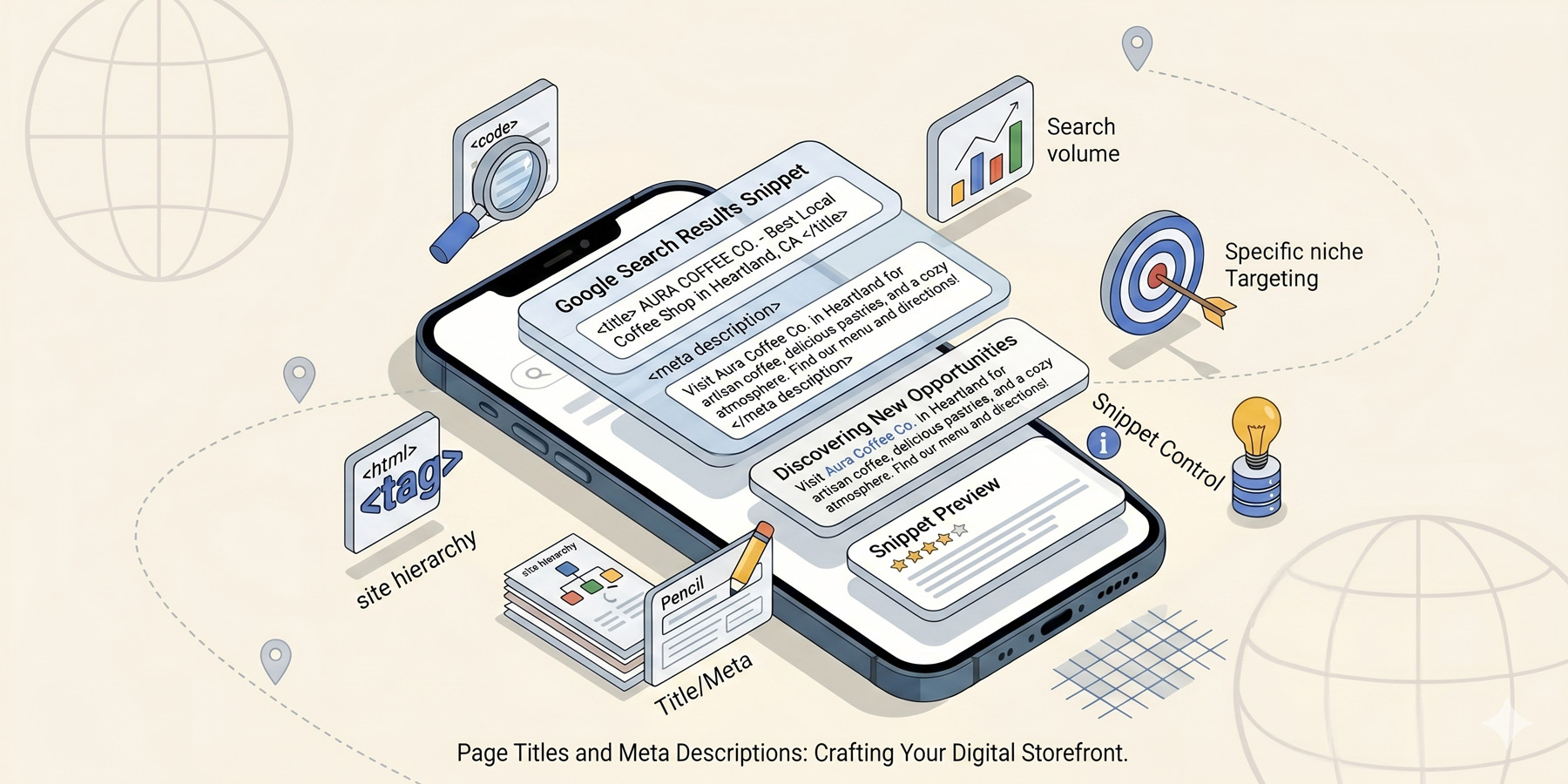
Map deliberately. Service pages get transactional keywords. Blog posts get informational and commercial ones. Each page has a unique target, optimised in its title and meta description, in its headings, and naturally throughout the content.
Read next
Once you’ve got your keyword list, the next step is using it properly on each page. Start with writing page titles and meta descriptions that get clicks. And for the bigger picture of how all this fits together, our complete SEO guide for South African small businesses is the place to start.
Need a hand?
Keyword research is the kind of work that’s straightforward in theory and tedious in practice. If you’d rather have it done properly by someone who’ll also build the rest of your SEO around it, see our SEO services or get in touch.