

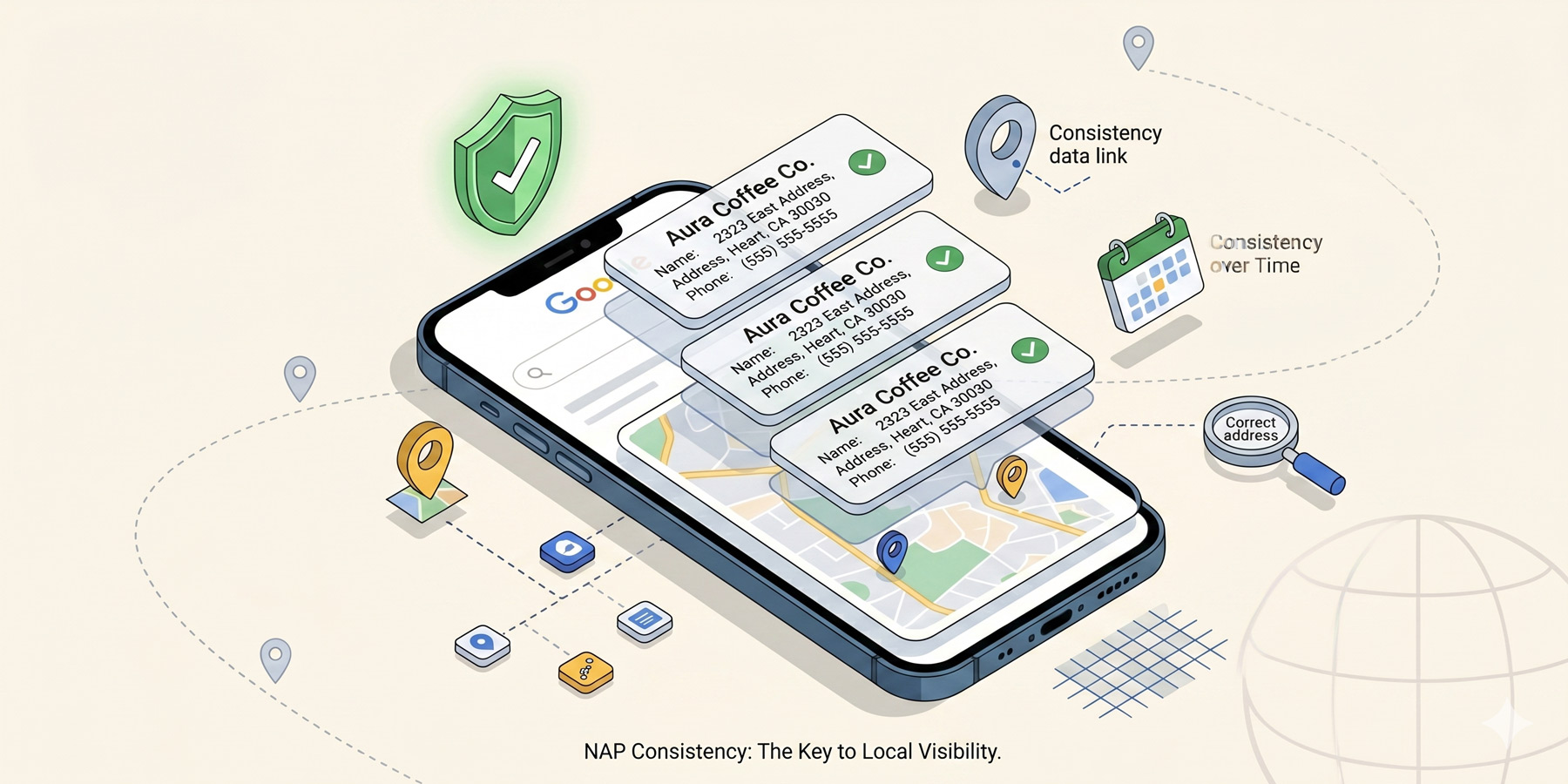
NAP stands for Name, Address, Phone. Three of the most boring pieces of information in your business, and three of the most powerful local SEO signals if you get them right.
NAP consistency means making sure your business name, address, and phone number are formatted identically everywhere they appear online. Sounds simple. Almost no small business is actually doing it. And the inconsistency is quietly costing them local search rankings.
Here is what NAP consistency is, why it matters more than you’d think, and how to audit and fix yours in an afternoon.
Why NAP consistency matters
Google cross-references your business details everywhere they appear (your website, Google Business Profile, Facebook, LinkedIn, directories, citation sites, industry listings) to verify that you are who you say you are. When the details match exactly, Google’s confidence in your business goes up, and so do your rankings.
When they don’t match (Bob’s Plumbing vs Bobs Plumbing vs Bob’s Plumbing Ltd, or 011 234 5678 vs +27 11 234 5678 vs (011) 234-5678) Google starts to wonder whether these are different businesses or one business with a sloppy presence. Either way, your local prominence signal weakens.
This isn’t a single dramatic ranking factor. It’s a quiet drag. Fix it and you’ll often see a small lift within a month or two.
Where your NAP appears
Most small businesses have 20 to 50 places online where their NAP appears, and they’ve never thought about most of them. The usual suspects:
- Your website (homepage, contact page, footer)
- Google Business Profile
- Facebook page
- LinkedIn company page
- Instagram bio
- Industry directories (specific to your trade)
- General directories (Yellow Pages, Cylex, Brabys for SA)
- Trade association listings
- Review sites (HelloPeter, etc.)
- Old supplier or partner websites
- Press releases and news articles
- Apple Maps and Bing Places
That’s before you count the places you’ve forgotten about: the conference you sponsored, the chamber of commerce profile, the local mom’s group that featured you. Each of those is a citation, and each one needs to match.
The consistency rule
Match the format exactly, everywhere. The basics:
- Business name. Pick one version and stick with it. “Bob’s Plumbing”, “Bobs Plumbing”, and “Bob’s Plumbing Pty Ltd” are three different entities as far as Google is concerned. Pick one.
- Address format. Suite or unit number first or last? Use abbreviations (“St” vs “Street”) or not? Pick one approach and apply it everywhere.
- Phone format. Use the international format (+27 11 234 5678) or a local one (011 234 5678) but use the same one everywhere. International is generally better for SEO and for international visitors.
Capitalisation, punctuation, and spacing all count. “John Smith Plumbing” and “John Smith plumbing” are not the same to a strict matching algorithm.
How to audit your existing listings
The free way:
- Google your business name in quotes (“Bob’s Plumbing Johannesburg”).
- Go through the first 5 pages of results and note every listing that mentions you.
- Open each one. Note the NAP exactly as it appears.
- Build a simple spreadsheet: URL, name, address, phone.
- Identify any that don’t match your canonical version.
The paid way: tools like Whitespark, Moz Local, or BrightLocal will scan dozens of citation sources for you and flag inconsistencies in minutes. For most SA small businesses, the free way is fine for an annual audit.
The citation cleanup process
Once you’ve got your list, fix the mismatches in priority order:
- Highest-authority sites first: Google Business Profile, your own website, Facebook, LinkedIn.
- Major directories: industry-specific listings, general SA directories like Brabys.
- Long-tail sites: forums, old supplier sites, anywhere you’ve been mentioned.
For your own website, fix it once. For directories, log in and update the listing. For sites you don’t control, email and ask politely.
Which directories matter for SA
You don’t need to be on every directory in existence. Focus on the ones South African customers and search engines actually use:
- Google Business Profile (non-negotiable)
- Facebook Business Page
- Apple Maps Business
- Bing Places
- LinkedIn Company Page
- Brabys
- Cylex SA
- HelloPeter (for review-driven industries)
- Your trade or industry association
Add 3 to 5 industry-specific directories on top. Don’t sign up for 100 random listing sites; the quality of citations matters more than the quantity.
Updating when you move
If you move office, change phone numbers, or rebrand, every citation needs updating. This is where having a spreadsheet of every listing becomes invaluable. Without one, you’ll be finding outdated listings for years.
Update Google Business Profile first. Then your website. Then the big platforms (Facebook, LinkedIn). Then work through your citation list. Allow a few weeks for everything to propagate.
The structured data bonus
If you want to take it one step further, add LocalBusiness schema to your website (specifically your contact page or footer). This is structured data that explicitly tells Google your NAP in a machine-readable format. Most SEO plugins for WordPress (Yoast, Rank Math) can generate this automatically once you fill in your business details in the plugin settings.
It’s a small extra signal but it helps with how your listing displays in search results.
Read next
NAP consistency feeds directly into your Google Business Profile and is part of the broader picture covered in our reviews guide. All three together are the foundation of local SEO for any South African small business.
Need a hand?
A citation audit isn’t difficult, but it is tedious. If you’d rather hand it over (along with the rest of your local SEO setup), see our SEO services or get in touch.